


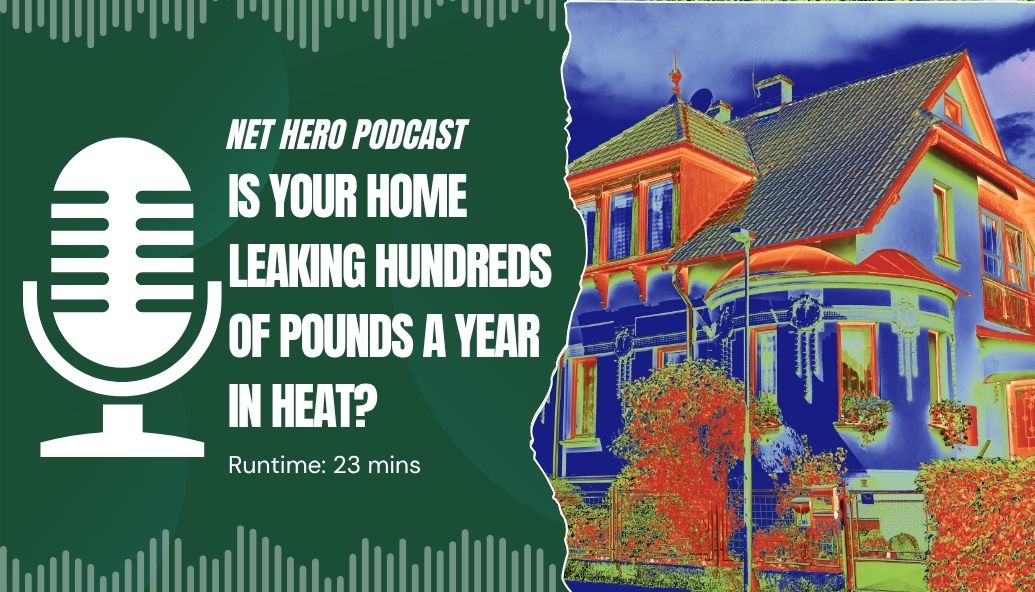
I have always known my house probably leaks heat. It’s old, poor insulation in the loft, none in the walls and with lots of windows, I suspect I would rather not know how much of the money I spend on heating simply disappears through the roof and walls.
Well with some clever tech, Lucy Lyons can now tell me.
She is the co-founder of Kestrix and on this week’s show, she explained how they are using drones, thermal imaging and AI to effectively create a heat map of our homes. Think Google Maps, but instead of finding the quickest route to the pub, you’re finding where your bloody heating bill is escaping.
And we need something like it because retrofitting Britain house by house is an enormous job.
“One of my favourite statistics is that in the UK alone, to reach net zero before 2050, we need to retrofit something like 1.8 homes every single minute,” Lucy told me.
“It’s ridiculous. It’s a massive undertaking. And so the question that we set out to solve was not just how do you figure out which home needs what. How do you do this in a way that’s really scalable and really empirical at the same time?”
Rather than sending somebody into every property, Kestrix can fly over an entire area and work out which homes need attention first.
“We’re going to fly the drones over, say, a thousand homes. And that’s going to help you figure out, okay, with the budget I have this year, which are the 250 that make the most sense to retrofit? What are the measures that each of those 250 need?”
That becomes particularly interesting when you can go back afterwards and see whether the work actually worked.
Kestrix did exactly that with housing provider Peabody and Lucy says the results showed an average bill saving of around £520 per home every year, alongside carbon savings of more than a tonne. But the cameras also spotted something else…
“There were indications of thermal bridging, which is kind of like heat loss essentially around the window lintels in about half the properties,” she explained. “It’s something to flag. There’s still unnecessary heat loss here and it might indicate that the home is less healthy than they thought.”
And this is what I liked about Lucy’s argument. Forget lecturing people about carbon. Show me my house, show me where the heat is disappearing and tell me what fixing it will save.
“If you understand the costs and the benefits of something, people are much more likely to buy in,” she said. “At the moment it’s like, ‘For the sake of the environment, you should really consider insulation.’ But okay, what about my house? What about my bills? No one can really answer that right now.”
…Maybe her drones and AI can. Listen to my full conversation with Lucy on the Net Hero Podcast, download it wherever you get your podcasts and please subscribe.
Copyright © 2026 Energy Live News LtdELN